Beyond the "Prompt"«
In the fast-paced world of artificial intelligence, the term "prompt engineering" has become a buzzword. Most people believe that mastering the art of writing the perfect question or instruction is the key to unlocking the full potential of Large Language Models (LLMs). It's perceived as the primary way to interact with AI—a creative dialogue between human and machine.
However, this view is just the tip of the iceberg. While the world focuses on perfecting prompts, a deeper, more systematic revolution is taking place in a discipline called "Context Engineering." This emerging field doesn't treat AI interaction as an art, but as a rigorous engineering problem. It considers all the information provided to an AI—instructions, documents, tools, and memory—not as a simple prompt, but as a complex "information payload" that must be scientifically designed, optimized, and managed.
This article will unveil five shocking revelations from recent research that will change the way you think about LLMs. We'll move beyond the idea of isolated prompts and delve into the science of context, the true engine driving today's most advanced and capable AI systems.
2. Takeaway 1: It's no longer "Prompt Engineering", it's "Context Engineering"«
The first fundamental shift in mindset is recognizing that the field is maturing. We are moving from the «art of prompt design» to the «science of information logistics.» The conversation is no longer about finding the magic words for a single prompt, but about how to systematically build and manage the entire information ecosystem that an AI agent needs to perform complex tasks.
Context Engineering is a formal discipline that systematically optimizes the entire information payload received by an LLM. This payload is not simply a user query, but a structured set of distinct components, each with a specific purpose.
- Instructions (
<strong>c_instr</strong>): The agent's "mission" or "laws of robotics." These define its purpose and its limits. - External Knowledge (
<strong>c_know</strong>): Their access to a real-time "library", obtained from sources such as documents or databases through RAG. - Definitions of Tools (
<strong>c_tools</strong>): The "user manual" for the tools you can use, such as APIs or software functions. - Memory (
<strong>c_mem</strong>): His "notebook" or "work diary," where he stores information from past interactions to maintain consistency. - User Inquiry (
<strong>c_query</strong>): The immediate and specific user request that triggers the task.

This shift is crucial because it allows us to move from creating simple chatbots to building complex, reliable, and capable AI systems. By treating context as an engineering problem, we can design agents that handle multi-step tasks, interact with the outside world, and maintain a consistent state across extended interactions.
«"It shifts the focus from the 'art' of prompt design to the 'science' of information logistics and systems optimization."‘
Practical Implication
For a developer or technical lead, this shift means moving from thinking like an "AI whisperer" to thinking like a systems architect. Instead of reactively adjusting prompts, the focus shifts to proactively designing the flow of information. This leads to more predictable, debuggable, and scalable systems, which are essential for production-level applications.
3. Takeaway 2: The biggest challenge for AI is not understanding, but creating
This is where things get counterintuitive. Thanks to context engineering and techniques like RAG, modern AI systems have achieved an astonishing capacity for understanding. An LLM can analyze thousands of pages of technical documents, find subtle connections, and answer specific questions about their content. However, their ability to generate content of equivalent complexity and length from scratch is significantly lower. This imbalance is precisely one of the core problems that Context Engineering seeks to mitigate.
The report «A Survey of Context Engineering«, which analyzed more than 1400 research articles, identifies this phenomenon as a «fundamental asymmetry». There is a significant gap between understanding and generating. In other words, the LLM is like a world-class literary critic who can deconstruct "One Hundred Years of Solitude" with astonishing accuracy, but who, if asked to write a novel of similar complexity, produces something incoherent and soulless.
This is one of the most surprising and critical challenges for the future of AI, as it limits its ability to move from being an information analyst to an autonomous creator of complex knowledge.
«"While current models, augmented by advanced context engineering, demonstrate remarkable competence for grasp complex contexts, exhibit pronounced limitations for trigger extensive and equally sophisticated content."»
Practical Implication
This knowledge compels you to design AI workflows that leverage the model's strengths. Instead of asking an agent to "write a full report on X," a more robust approach is to break down the task (what I call the "divide and conquer" technique): "First, analyze these documents and extract the key points. Then, create a detailed outline. Finally, draft each section based on the outline and the extracted points." This phased approach uses the LLM's excellent comprehension skills to guide its weaker generation, resulting in a higher-quality final product.
4. Takeaway 3: AI Agents Don't Memorize; They Take Notes and Look for Information
One of the biggest misconceptions about AI agents is imagining them with a perfect, massive memory. The reality is much more ingenious. To solve the finite memory problem, modern agent architectures adopt a "just-in-time information" principle.just-in-time).
Instead of loading entire databases into memory, the agent stores lightweight references, such as file paths or database queries. When it needs specific information, it uses its tools to retrieve it precisely when it is relevant. Often, this "search" mechanism is based on the same RAG architecture (described in the next section) that uses embeddings and vector databases to find the most semantically relevant information.
In addition, agents use a form of structured note-taking. An agent can maintain their own log. NOTES.md or a to-do list to record their plan, the architectural decisions they've made, and the intermediate results. These notes persist outside the main, limited context window. At each step, the agent can consult their notes to recall the overall plan, avoiding being overwhelmed by potentially irrelevant information and allowing them to tackle complex problems that unfold over thousands of steps.
«"This approach reflects human cognition: we generally do not memorize entire corpora of information, but instead introduce external systems of organization and indexing such as file systems, inboxes and bookmarks to retrieve relevant information on demand."»
Practical Implication
This changes how we design tasks for agents. Instead of providing all the information upfront, we need to equip agents with the right tools so that find information on their own. This involves giving them access to search engines, databases, or file systems. It also means that part of the prompt is teaching them to be good note-takers, instructing them to update a plan or draft as they go.
5. Takeaway 4: Unstructured Data Learns to "Speak Mathematics"«
It is estimated that over 801,000% of the world's data is unstructured: text, images, PDFs. LLMs, which are essentially mathematical machines, cannot process this information directly. The key to unlocking it is a process called "embedding." An embedding transforms unstructured data into a high-dimensional vector, which is essentially a long list of numbers.
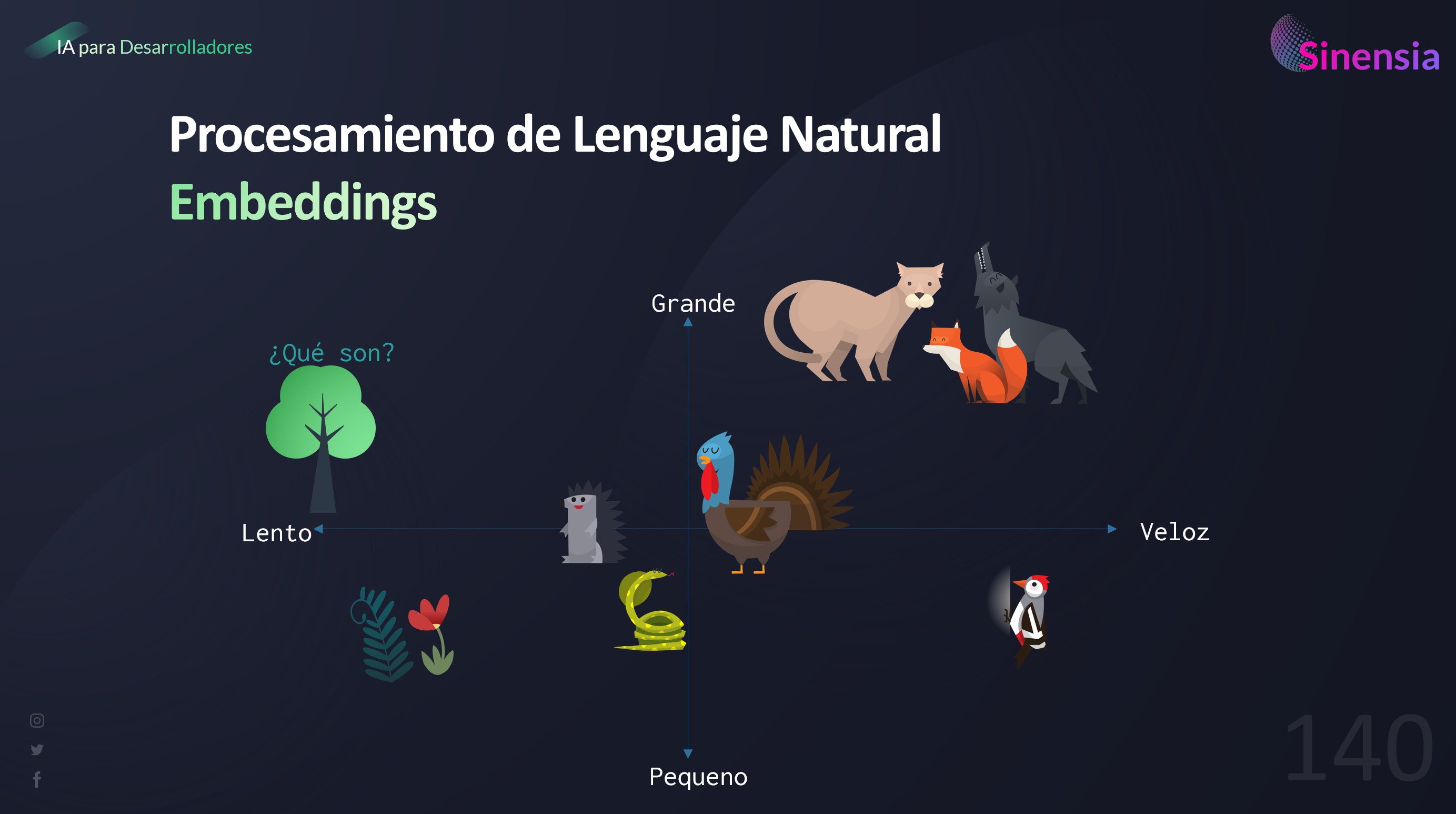
To understand this, let's use an analogy. Imagine we want to create a vector for the word "King." An embedding model, automatically and without human intervention, learns to generate semantic features like "gender," "wealth," or "power" and assign numerical values to them. The result could be a vector like [1, 1, 1, 0.8, 1]. The crucial point is that these characteristics are not predefined by us, but are abstract dimensions in a semantic space that the model discovers during its training.
These vectors are stored in a "Vector Database." The magic lies in the fact that semantically similar concepts end up with mathematically close vectors in this space. The "Queen" vector would be very close to the "King" vector. When an agent needs to find information, it converts its query into a vector and searches the database for the closest vectors. This is the fundamental mechanism behind Recall Augmented Generation (RAG).
(An analogy I use to explain embeddings in my AI course as a vector representation of meaning)
Practical Implication
Mastering embedding and vector databases is fundamental for any AI application that needs to leverage proprietary knowledge. It allows you to build "ask your documents" systems, customer support chatbots that understand your product manuals, or research tools that can find relevant information across thousands of articles. It's the bridge between the general knowledge of an LLM and the specific data of your domain.
6. Takeaway 5: AI Needs a «USB Port» to Talk to the World (and It’s Called MCP)
For AI agents to be useful, they need to interact with the outside world: search for code in a repository, create a issue on GitHub or access a database in Salesforce. Historically, each integration was a custom project, leading to an "architectural fragmentation" that made it difficult to build complex systems.
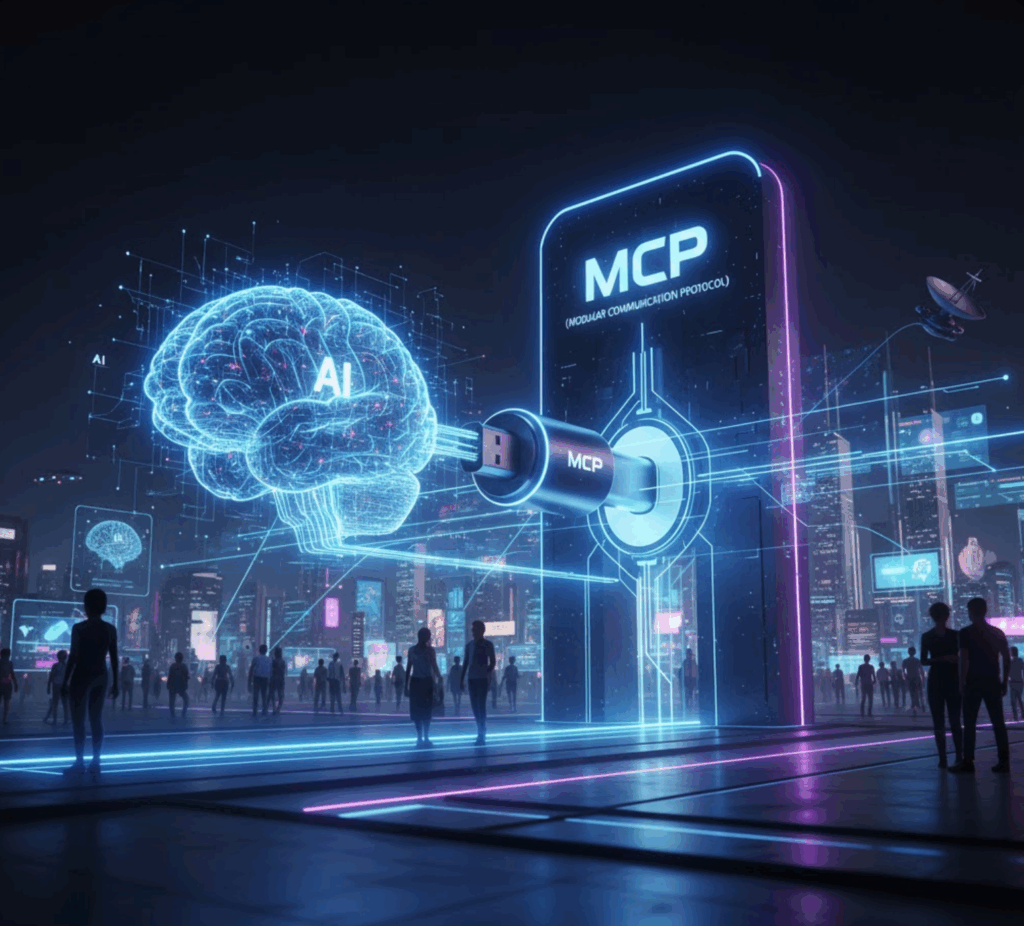
The Model Context Protocol (MCP) is an open standard that solves this problem. It defines a common way for LLMs to communicate with external tools, acting as the standardized implementation of the component. c_tools of the context payload. The best analogy to understand this is the following:
«"Think of the MCP as a universal translator for AI applications: just as USB ports allow you to connect any device to your computer, the MCP allows AI models to connect to any tool or service in a standardized way."»
This standardization is a game-changer. It allows developers to build tools that any MCP-compliant agent can use without custom adaptations, which is crucial for creating complex, multi-agent systems. Thanks to MCP, a server ecosystem is already growing for tools like GitHub, Salesforce, Slack, and PostgreSQL, laying the foundation for a new generation of interoperable AI applications.
Practical Implication
MCP is key to scalability and composability in agentic AI. For architects, this means they can design systems where agents are interchangeable and tools are reusable. Instead of building monolithic and fragile integrations, you can build an ecosystem of AI microservices, where each tool exposes a standard MCP interface. This accelerates development and increases the overall robustness of the system.
7. Conclusion: The New Frontier of AI
The five points above reveal a fundamental paradigm shift. True innovation no longer lies in the art of crafting the perfect prompt, but in the engineering discipline of designing the entire context in which an LLM operates. Context Engineering is the unifying field that addresses the systemic challenges of modern AI: it bridges the gap between understanding and generating, implements efficient memory systems, translates the unstructured world into mathematics, and standardizes interaction with the real world.
These aren't isolated tricks; they're the interconnected pillars of a new engineering reality. Mastering the science of context, not just the art of prompts, is the skill that will define the next era of AI development. This discipline will allow us to create the next generation of more powerful, reliable, and autonomous agents, capable of tackling problems of a complexity that was previously beyond our reach.
As we master this science, an exciting question arises: what new possibilities will open up when AI can not only understand almost anything, but also reliably create and act upon that understanding in the real world?
 English
  Spanish